Drawn from clinical practice since 1999. It is set in the same classical key: case at the centre, remedy at the periphery, the patient’s own language as the only measure of progress.
Publications
One book, three languages
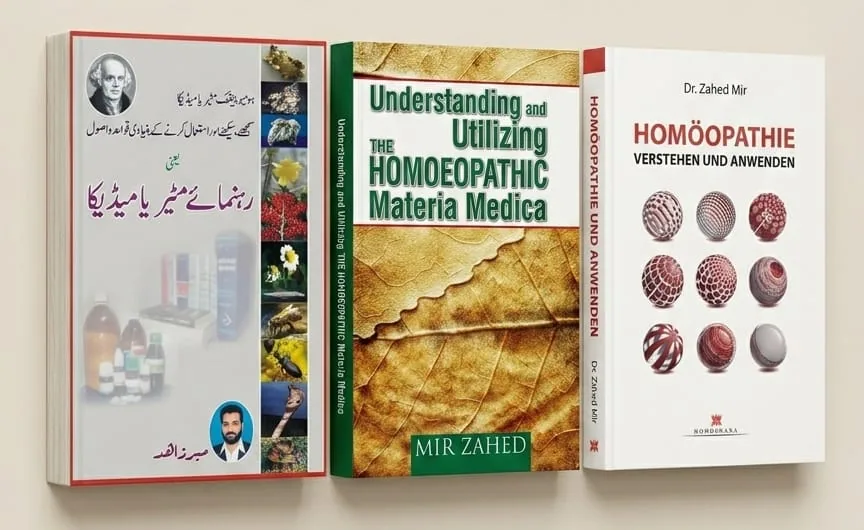
Understanding and Utilizing the Homoeopathic Materia Medica
A working method for reading the Materia Medica as a living portrait of remedies. How to perceive the essence of a medicine and match it to the person before you.
Editions
- EnglishB. Jain Publishers · 2013Find it (opens in a new tab)
- GermanHomöopathie Verstehen und Anwenden · SHI Haus der Homöopathie · 2011Find it (opens in a new tab)
- UrduRahnuma-e-Materia Medica · Raheem Homeopathic Publishers, Lahore · 2008
Presentations
Presented to the profession
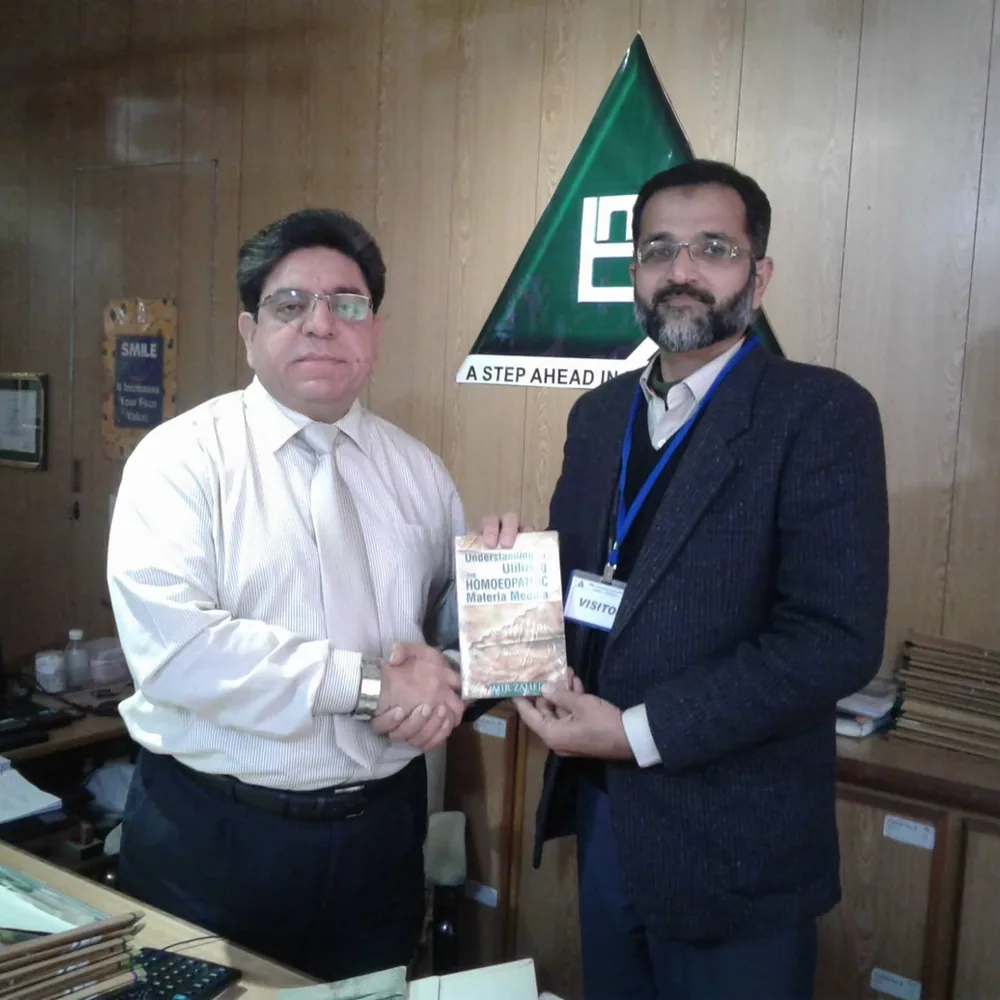
Dr. Aman Ullah BismilChief Executive, BM Pharmacy, Lahore 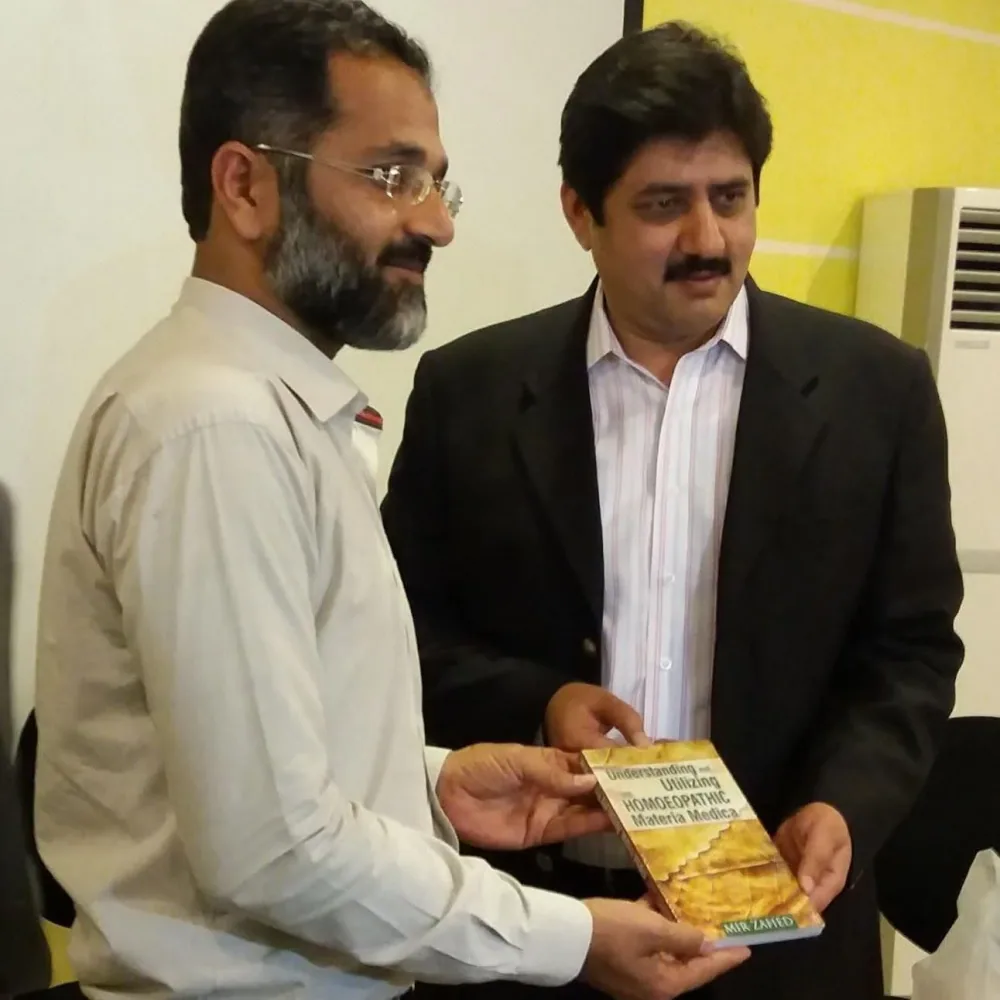
Dr. M. Zubair QureshiChief Executive, Masood Homeopathic Pharmacy, Lahore
ForewordsSix forewords,
Six forewords,
from internationally renowned homeopaths
Written for the book by teachers and practitioners of homeopathy. Open any one to read it through.
Dr. Chaudhery Ahmad Hassan
Read Dr. Mir’s book, start your study of Nash, Kent and George, assimilate the law of cure and enjoy serenity and tranquility by performing valuable cures.ReadClose
Sargodha · 19 September 2008
Now a few words for this book. While homoeopathic materia medica is our main armamentarium that is used in the fight against disease and ill health, a fuller knowledge of its components, designs and purposes is presented nowhere in lucid and compact form for the students of homoeopathy. This was Dr. Mir’s share that he felt this need of the beginners and met the same for them successfully. Dr. Mir’s book is a practical guide to the study and use of homoeopathic materia medica and it demonstrates successfully the use and importance of different types of symptoms, sensations, modalities, causations and conditions that comprise the portraits and individualities of our medicines. Thus by making the study of materia medica a living, dynamic and enjoyable process, Dr. Mir has contributed a valuable treatise to the literature of homoeopathy.
Now my advice to the student—Read Dr. Mir’s book, start your study of Nash, Kent and George, assimilate the law of cure and enjoy serenity and tranquility by performing valuable cures.
Dr. Navneet Bidani
All in this entire book is not only to be recommended to homoeopaths, but I would say it is a “must”. But not only a must, it’s a delight and a joy to have it and work with it.ReadClose
Director, Dr. Bidani’s Centre for Homoeopathy
Knowledge, in all its aspects, brings our understanding to the fore. However you define excellence in prescribing, knowledge is always an essential ingredient. Who we are as a person is the most important factor in how we live our life, and thus also in how we practice as a homoeopath. Dr. Zahed’s ‘UNDERSTANDING & UTILIZING THE HOMOEOPATHIC MATERIA MEDICA’, a superb collection of his essays & lectures, weaves these insights, among many others, into the fabric of what homeopathy is, how it works and what it means to be a homeopath.
The author has spared himself no pains in his endeavour to present the main ideas in the simplest and most intelligible form, and on the whole, in the sequence and connection in which they actually originated. The wealth of detail, the infinite care never to let anything pass unexplained, with which he presented to the students of Homoeopathy the result of his experience, are impressive & worth appreciating. All in this entire book is not only to be recommended to homoeopaths, but I would say it is a “must”. But not only a must, it’s a delight and a joy to have it and work with it.
Kathy Thomas
Rote learning will only allow us to pass tests. So, it is only through understanding that practitioners will be able to utilize the treasures held within the materia medica.ReadClose
Senior Lecturer and Associate Principal of Homeopathy (South Pacific College of Homeopathy)
The practice of homeopathy in the 21st century is both a skilled art and a complex science. Consequently, it is a difficult discipline to master. Successful homeopaths know this and devote time exploring ways in which they can perfect their art in order to best serve their patients. As James Compton-Burnett wrote: The fact is we need any and every way of finding the right remedy.
Being well-versed in classical theories is as important as getting to grips with contemporary methodologies and this is where Dr Zahed’s book is useful. For the beginner homeopathic student, this book provides invaluable insight into the use of one of our tools of trade – the materia medica. The first chapter title hints at the content of the book – to memorize or to understand! Dr Zahed knows that in order to master materia medica, we must first understand it. Rote learning will only allow us to pass tests. So, it is only through understanding that practitioners will be able to utilize the treasures held within the materia medica.
And this is what Dr Zahed’s book does. It takes us on a journey of discovery in which the characteristics of materia medica and the terminology associated with it are explained clearly and with vigour.
A useful chapter on potency presents the reader with a wide range of traditional viewpoints. This is a difficult subject. However, Dr Zahed’s summary at the end of the chapter adds clarity.
Liberal use of quotes from the homeopathic masters, as well as case examples, add interest to the text.
This is a useful book for a student of homeopathy which facilitates understanding of some basic principles. Hopefully it will also stimulate interest in further research of masters’ work and perhaps even arouse curiosity about contemporary homeopathy.
Congratulations to Dr. Zahed for simplifying the study of materia medica and making it accessible to newcomers.
- RCHom, Advanced Diploma in Homeopathy (NZ)
- Diploma in Teaching, Diploma in Second Language Teaching, Bachelor of Arts (English and Maths)
Kathy Desjardins
I highly recommend that all students who have started on their journey of Homeopathic Medicine should read this book. In addition I suggest that all Homeopathic Schools should recommend this book on the required reading list for year one.ReadClose
Director, Homeopathic Academy of Niagara (Canada)
Dr. MIR and I began corresponding some time ago in relation to his desire to teach at the Homeopathic Academy of Niagara, in Canada. He delivered here (via internet and phone) some useful lectures and then our planned topic was “How to study Materia Medica.” When he started writing on this topic it became a book.
Upon reading this work I was very impressed with the information that Dr. MIR had written. For beginning students of Homeopathy, as we know, there are very few good books that one can find to start on his studies. Either the books are for general purposes, like first aid, or they are too in depth of new studies of this profession.
Dr. Mir’s “UNDERSTANDING & UTILIZING The Homoeopathic Materia Medica” is an excellent book for beginning students of Homeopathic Medicine. As a teacher of Homeopathic Medicine I find the information that Dr. MIR has presented here an excellent starting point for my students. The messages are clear, concise and give a wonderful introduction into the complex studies of Homeopathic Medicine.
I highly recommend that all students who have started on their journey of Homeopathic Medicine should read this book. In addition I suggest that all Homeopathic Schools should recommend this book on the required reading list for year one.
It is with great honor, thanks and appreciation that I write these words for Dr. MIR.
Dr. Manish Bhatia
Students, who often get confused due to the mass of information in our medicines, will find this book very useful.ReadClose
Jaipur · 22 May 2008
In the last few decades, more than 2000 new remedy names have appeared in homeopathic literature. There have been many philosophical advancements too, leading to varied interpretation and use of our Materia Medica. Many new books covering new remedies, consolidating historical data and text books for students have been published. But there have been few attempts to present the study of Materia Medica in a systematic and coherent way. Dr. Zahed’s book “UNDERSTANDING & UTILIZING The Homoeopathic Materia Medica” fills this gap. This work covers different facets of our remedies, discusses relative merit of different symptoms, different approaches to study them, explores the existing literature and presents the data in a very lucid manner. Students, who often get confused due to the mass of information in our medicines, will find this book very useful. I hope this work will serve as a guide to our young students for many years to come and illuminate the path for studying our Materia Medica.
Dr. Mohinder Singh Jus, DMS (Cal)
Materia Medica cannot and should not be memorized but understood. This is the main theme so excellently discussed in this book.ReadClose
Director of SHI Homoeopathic College and Clinic
Materia Medica cannot and should not be memorized but understood. This is the main theme so excellently discussed in this book. It is written in the tradition of Dr. Kent who taught us to understand the homoeopathic remedies as personalities. Being myself a Kentian Homoeopath and teacher, I read this book with great joy and was pleased to write the foreword.
The author explains his method to read and understand materia medica and includes view points of renowned homoeopaths. He illustrates this subject with very valuable examples. He emphasizes about the importance of understanding all aspects of a remedy such as source of the remedy, characteristic symptoms, general and particular symptoms, duration of action and comparison with other remedies. Interestingly he elaborates the importance of knowing the source of a drug, as to why it affects particularly on specific systems or organs and how it reflects certain similarity to another drug. He recommends that the remedies should be studied under various groups e.g. “cold remedies; hot remedies”. This helps the homoeopath to select the correct remedy.
For a beginner, it is always difficult to grasp the method of evaluation of symptoms. Dr. Zahed skilfully emphasizes the importance of gradation of symptoms in the Kentian way that is mental symptoms, generals and locals. He underlines the significance of modalities in the selection of a remedy. He has thoroughly discussed the subject of drug relationship. This is a much disputed subject. Some of the modern homoeopaths even do not consider it of any importance. They find the mention of complementary, follow-up remedies, inimicals or antidotes as irrelevant. I personally think that it is a shame to ignore the centuries old experience of innumerable renowned and dedicated homoeopaths who witnessed these effects in their busy clinics. It is a great compliment to Dr. Zahed for having laid emphasis on such a subject which is vast and very useful. To select the right remedy alone is not enough. It is its comprehensive use and follow-up of the case which is challenging. In my experience, in order to accomplish a cure, it is imperative to take into account the drug relationships. They are like a compass to the treating homoeopath.
After having extensively discussed the drug relationships, the author goes into another very important subject: the potencies. He has given very interesting and valuable view points of various homoeopaths. This should be very helpful in determining the correct potency as to the gravity of the case and personal sensitivity of the patient.
All in all this work from Dr. Zahed will go a long way to help all the beginners and advance students of homoeopathy. With its easily comprehensible language and text, this book is a big service to the homoeopathic profession. I wish Dr. Zahed all the best and congratulate him for his achievement.
- Founder and president of Dr. B.K. Bose Trust
- Editor of Similia, quarterly homoeopathic journal
- Lecturer in SHI Homoeopathic College and in various foreign countries
- Author of many books such as: Journey of a disease – a comprehensive study of miasms, Children Types, Practical Materia Medica, Homoeopathic First aid, Homoeopathic treatment of injuries
His clinical writing — the journals he contributes to and the case reports themselves — has its own page.
Published casesHave a question about the book?
The practice is happy to discuss the book and how it fits into a course of study.